
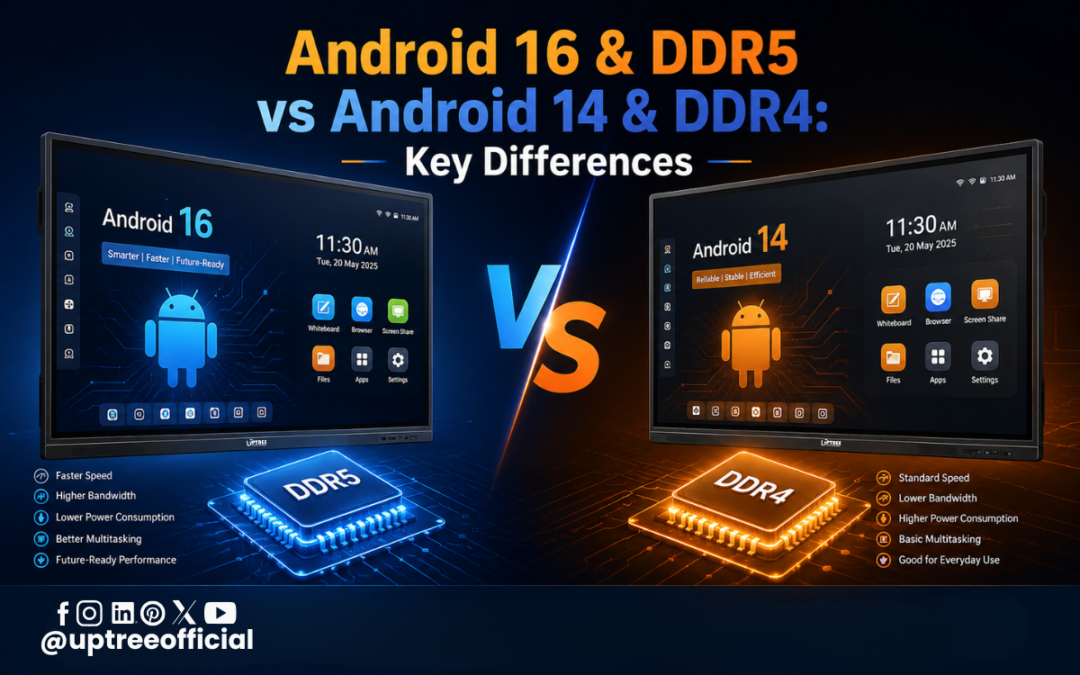
Android 16 & DDR5 vs Android 14 & DDR4: Key Differences
Android 16 & DDR5 vs Android 14 & DDR4: Key Differences is an important comparison for schools, businesses, training centers, and organizations planning to upgrade their interactive flat panel technology. As interactive displays become more advanced, the combination of a newer Android operating system and faster DDR5 memory can significantly influence overall responsiveness, multitasking, application performance, and long-term usability. Uptree brings modern interactive flat panel solutions designed to support smarter classrooms, collaborative workplaces, and engaging digital environments.
When selecting an interactive flat panel, many buyers focus mainly on screen size, resolution, touch points, and design. However, the internal hardware and operating system are equally important. The Android version determines the software environment and available features, while RAM technology directly affects how efficiently the system handles applications and multitasking. This makes Android 16 & DDR5 vs Android 14 & DDR4: Key Differences a useful comparison for anyone evaluating a modern interactive panel.
Understanding the Technology
Before exploring Android 16 & DDR5 vs Android 14 & DDR4: Key Differences, it is important to understand what Android and DDR memory do inside an interactive flat panel.
Android is the operating system that allows users to access applications, settings, digital tools, browsers, media, whiteboard applications, and other smart-panel functions. A newer Android generation can provide a more modern software environment, improved compatibility, security improvements, and support for newer applications.
DDR stands for Double Data Rate memory. RAM temporarily stores data that the processor needs while applications are running. DDR5 is a newer memory generation than DDR4 and is designed to provide higher memory bandwidth and improved efficiency.
Therefore, Android 16 & DDR5 vs Android 14 & DDR4: Key Differences is not simply about two Android versions or two RAM generations. It is a comparison of the overall computing experience created by the operating system and memory technology working together.
1. Operating System: Android 16 vs Android 14
The first major point in Android 16 & DDR5 vs Android 14 & DDR4: Key Differences is the operating system.
Android 16 represents a newer software generation than Android 14. A modern operating system can provide a more updated platform for applications and smart-device functionality. For interactive flat panels, this can be particularly valuable because users increasingly expect the display to work as a complete smart computing device rather than simply as a large touchscreen.
Android 16 can support a modern user experience with improved software capabilities and compatibility with newer applications. This can help schools and businesses keep their interactive panels useful as their software requirements evolve.
Android 14 remains a capable operating system, but Android 16 provides a newer foundation. When organizations are purchasing a panel intended to remain in service for several years, choosing a newer software platform can help improve its long-term relevance.
This is one of the most important Android 16 & DDR5 vs Android 14 & DDR4: Key Differences because the operating system influences almost every software interaction on the panel.
2. Memory Technology: DDR5 vs DDR4
The second major point in Android 16 & DDR5 vs Android 14 & DDR4: Key Differences is RAM technology.
DDR4 has been widely used across computers and smart devices for years. It provides reliable performance for everyday computing tasks. DDR5, however, is a newer memory technology designed to provide greater bandwidth and improved efficiency compared with earlier generations.
In an interactive flat panel, faster memory can contribute to smoother handling of applications and data. When users switch between applications, open large files, use web-based tools, display multimedia, or work with interactive educational software, the system needs sufficient memory performance to keep operations responsive.
The benefits of DDR5 become especially relevant when an interactive panel is being used as a multifunctional device. A teacher may use a browser, digital whiteboard, educational application, presentation, video, and annotation tools during one session. Similarly, a business professional may move between presentations, documents, video meetings, web applications, and collaboration tools.
Therefore, Android 16 & DDR5 vs Android 14 & DDR4: Key Differences demonstrates why RAM technology should be considered alongside the operating system.
3. Multitasking and Application Performance
Another important aspect of Android 16 & DDR5 vs Android 14 & DDR4: Key Differences is multitasking.
Modern interactive flat panels are expected to handle more than one task. Users may open a digital whiteboard while referring to online content, display a presentation, annotate documents, or use multimedia resources. In business environments, users may switch between presentations, browser windows, documents, and meeting applications.
DDR5 offers higher memory bandwidth than DDR4, which can be beneficial when the system is moving data between the processor and memory. Combined with a capable processor and sufficient RAM capacity, this can contribute to a more responsive multitasking experience.
Android 16 also provides a newer software environment for running applications and managing system functions. The combination can make a modern panel better suited to workloads that require frequent application switching.
However, actual performance depends on the complete hardware configuration, including processor, RAM capacity, storage, software optimization, and application requirements. This is an important consideration when reviewing Android 16 & DDR5 vs Android 14 & DDR4: Key Differences.
4. Faster and Smoother User Experience
User experience is another important factor in Android 16 & DDR5 vs Android 14 & DDR4: Key Differences.
An interactive flat panel should respond quickly when users touch the screen, open applications, write on the whiteboard, browse content, or switch between functions. Delays can interrupt lessons, presentations, meetings, and demonstrations.
A modern hardware configuration using DDR5 can provide greater memory bandwidth, while a newer Android platform can provide an updated software environment. Together, these technologies can support a smooth and responsive experience when paired with appropriate hardware.
For teachers, this means less interruption during lessons. For corporate users, it can mean smoother presentations and collaboration. For training centers, it can make demonstrations more engaging.
This is why Android 16 & DDR5 vs Android 14 & DDR4: Key Differences should be evaluated from the perspective of real-world usability rather than specifications alone.
5. Long-Term Technology Value
The fifth major point in Android 16 & DDR5 vs Android 14 & DDR4: Key Differences is long-term value.
Interactive flat panels are typically installed for extended periods. Schools may use them for classroom teaching, while businesses may deploy them in meeting rooms, training areas, reception spaces, and collaboration zones. Replacing the panel frequently can increase costs and disrupt operations.
Choosing newer technologies can help organizations prepare for future software and application requirements. Android 16 provides a newer operating system foundation, while DDR5 represents a newer memory architecture.
This does not automatically mean every Android 16 and DDR5 panel will outperform every Android 14 and DDR4 panel in every situation. The processor, storage, RAM capacity, display technology, software optimization, touch system, and other components all matter.
Nevertheless, when comparing systems with otherwise similar specifications, the newer platform can provide stronger future-readiness.
Android 16 and DDR5 for Interactive Flat Panels
The combination of Android 16 and DDR5 can be particularly useful for modern interactive flat panels. This is where Android 16 & DDR5 vs Android 14 & DDR4: Key Differences becomes relevant to schools and businesses planning their next technology investment.
A modern interactive flat panel can combine 4K visual quality, multi-touch interaction, digital whiteboarding, wireless collaboration, multimedia playback, screen sharing, and application support in a single device.
With a newer operating system and faster memory architecture, users can expect a platform designed around current digital requirements. Features such as digital annotation, screen recording, content sharing, web browsing, presentations, and interactive applications can all benefit from a responsive computing environment.
For example, a teacher can use the interactive panel to display a lesson, write directly on the screen, open educational resources, show videos, and share notes with students. In an office, employees can use the same type of panel for presentations, brainstorming, video meetings, and collaborative work.
The practical advantages make Android 16 & DDR5 vs Android 14 & DDR4: Key Differences particularly important when planning a new digital classroom or smart office.
Android 14 and DDR4: Where They Still Fit
While discussing Android 16 & DDR5 vs Android 14 & DDR4: Key Differences, it is also important to recognize that Android 14 and DDR4 are not automatically unsuitable.
Android 14 can provide a reliable platform for everyday applications, browsing, presentations, digital whiteboarding, and multimedia. DDR4 memory can also handle many common workloads effectively when paired with suitable hardware.
For organizations with basic interactive display requirements, an Android 14 and DDR4 configuration may provide adequate functionality. Budget considerations can also influence purchasing decisions.
However, organizations that want a newer platform and greater future-readiness may prefer a configuration built around newer technologies.
The right choice depends on intended usage, required applications, hardware specifications, budget, and expected service life. This balanced approach is essential when evaluating Android 16 & DDR5 vs Android 14 & DDR4: Key Differences.
Why Hardware and Software Should Be Considered Together
One of the biggest lessons from Android 16 & DDR5 vs Android 14 & DDR4: Key Differences is that the operating system and RAM should not be evaluated independently.
A newer operating system can provide a modern software environment, but its performance also depends on the underlying hardware. Similarly, DDR5 can provide greater memory bandwidth, but the overall system experience depends on the processor, storage, RAM capacity, display controller, and software optimization.
For this reason, buyers should evaluate the complete specification sheet instead of selecting a panel based on one feature.
Important specifications to consider include:
- Android operating system version
- RAM type and capacity
- Processor generation and performance
- Internal storage
- Display resolution
- Touch technology
- Brightness
- Speaker system
- Connectivity options
- Wireless screen sharing
- Whiteboard software
- Security features
- Warranty and after-sales support
- Upgrade and service options
Looking at the complete configuration provides a more accurate understanding of Android 16 & DDR5 vs Android 14 & DDR4: Key Differences.
Benefits for Smart Classrooms
For educational institutions, Android 16 & DDR5 vs Android 14 & DDR4: Key Differences can influence the effectiveness of a digital classroom.
Teachers increasingly use multimedia presentations, digital textbooks, online resources, interactive simulations, educational videos, and collaborative activities. These applications require a responsive device that can quickly handle different types of content.
An Android 16 interactive flat panel with DDR5 memory can provide a modern foundation for these activities. Teachers can move between resources, annotate content, access online material, and interact with students using a single display.
The technology can also support more engaging lessons by combining touch interaction with multimedia content. Students can participate directly instead of simply watching a conventional display.
Benefits for Businesses
Businesses can also benefit from understanding Android 16 & DDR5 vs Android 14 & DDR4: Key Differences.
Modern meeting rooms require technology that can support presentations, video conferencing, collaboration, document sharing, brainstorming, and digital communication. An interactive flat panel can consolidate many of these functions into one large touchscreen platform.
A responsive system can help presenters move quickly between slides, documents, websites, videos, and collaboration applications. Users can also annotate information directly on the display.
For training departments, interactive panels can make employee learning sessions more dynamic. For management teams, they can support brainstorming and strategic discussions.
Why Choose Uptree Interactive Flat Panels?
Uptree focuses on providing technology solutions designed for modern educational and professional environments. Uptree Interactive Flat Panels are developed to support interactive learning, collaboration, presentations, and digital communication.
When evaluating Android 16 & DDR5 vs Android 14 & DDR4: Key Differences, Uptree can help organizations understand which configuration best matches their requirements.
A modern Uptree interactive flat panel can bring together a large 4K display, multi-touch interaction, digital whiteboarding, smart Android functionality, connectivity options, and other productivity-focused features.
For schools, the panel can become the central platform for digital teaching. For businesses, it can support meetings, presentations, collaboration, and training.
Uptree also offers solutions that can complement interactive panels, including OPS systems, PTZ cameras, all-in-one PCs, digital classroom solutions, and other smart technology products.
Making the Right Choice
The comparison of Android 16 & DDR5 vs Android 14 & DDR4: Key Differences ultimately comes down to the requirements of the organization.
If the goal is to obtain a newer platform with modern memory technology, Android 16 with DDR5 can be an attractive choice. It provides a more current software and memory combination and can be better suited to organizations planning for long-term usage.
If the requirement is for basic interactive functionality and budget is the primary consideration, Android 14 with DDR4 may still meet the needs of certain users.
Before purchasing, organizations should identify how the panel will be used. Consider the number of applications, expected multitasking, multimedia requirements, connectivity needs, number of users, and expected lifespan.
A good purchasing decision should focus on total system performance rather than one specification.
Final Thoughts
Android 16 & DDR5 vs Android 14 & DDR4: Key Differences shows how both software and memory technology contribute to the evolution of interactive flat panels. Android 16 provides a newer operating system platform, while DDR5 offers newer memory technology with greater bandwidth and efficiency potential compared with DDR4.
For schools and businesses looking for a modern interactive display, the combination of updated software and newer hardware can provide a strong foundation for digital learning and collaboration. However, buyers should always evaluate the complete configuration, because processor performance, RAM capacity, storage, display quality, software optimization, connectivity, and after-sales service all contribute to the final user experience.
As interactive technology continues to develop, choosing a platform that can support current requirements while remaining relevant for future applications becomes increasingly important. Android 16 & DDR5 vs Android 14 & DDR4: Key Differences is therefore more than a technical comparison—it is a guide for organizations planning their next investment in interactive display technology.
With the right interactive flat panel, schools can create more engaging classrooms, teachers can deliver multimedia-rich lessons, and businesses can improve meetings and collaboration. Uptree aims to support these requirements with modern interactive technology solutions designed for today’s digital environments.
For organizations considering an upgrade, understanding Android 16 & DDR5 vs Android 14 & DDR4: Key Differences can help make the selection process clearer. A well-matched interactive flat panel can become a valuable long-term technology investment, supporting teaching, presentations, communication, collaboration, and digital transformation across multiple environments.
To learn more about the Uptree Interactive Flat Panel, explore our related blogs:
-
Top 5 Benefits of Android 16 Interactive Flat Panel: Read More
-
Android 16 Interactive Flat Panel for Modern Classrooms: Read More
-
Key Advantages of EDLA-Certified Android 16 IFP: Read More