
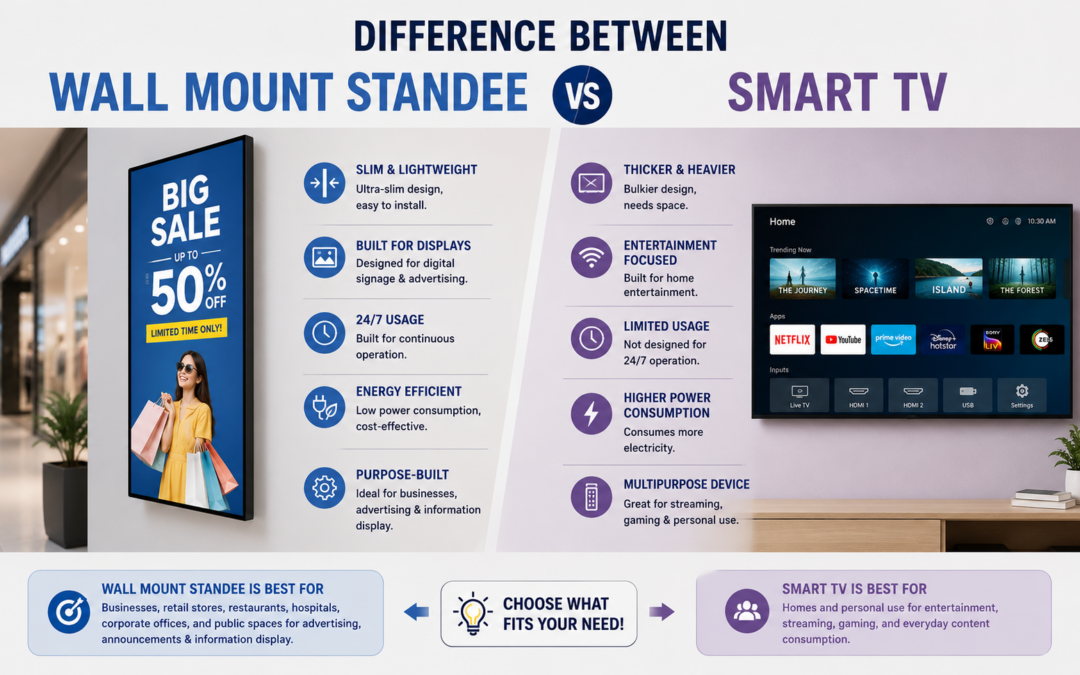
Difference Between a Wall Mount Standee and a Smart TV
Difference Between a Wall Mount Standee and a Smart TV is one of the most common questions businesses ask when planning to invest in digital display solutions. While both devices feature digital screens and can display visual content, they are designed for entirely different purposes. A Smart TV is primarily built for entertainment and home viewing, whereas a Wall Mount Standee is specifically developed for commercial advertising, branding, customer engagement, and digital signage.
In today’s competitive business environment, attracting customer attention is more challenging than ever. Companies are constantly searching for innovative ways to communicate with their audience, showcase products, and improve customer experiences. This is where digital display solutions play a crucial role.
At Uptree Consultancy Services Private Limited, we help businesses transform their communication strategies through advanced digital signage solutions. Understanding the Difference Between a Wall Mount Standee and a Smart TV can help organizations make better purchasing decisions and maximize their return on investment.
Understanding Wall Mount Digital Standees
Before exploring the Difference Between a Wall Mount Standee and a Smart TV, it is important to understand what a Wall Mount Standee is.
A Wall Mount Digital Standee is a professional-grade digital signage display that is mounted on a wall and used to showcase advertisements, promotional offers, announcements, product information, videos, menus, and other business-related content.
Unlike traditional posters or banners, wall mount digital standees allow businesses to update content instantly without reprinting marketing materials.
Wall mount standees are commonly used in:
- Retail stores
- Shopping malls
- Restaurants
- Hotels
- Hospitals
- Educational institutions
- Corporate offices
- Airports
- Banks
- Exhibition centers
These displays are specifically designed for continuous operation and commercial environments.
Understanding Smart TVs
To fully understand the Difference Between a Wall Mount Standee and a Smart TV, we must also understand the role of Smart TVs.
A Smart TV is an internet-connected television that offers entertainment features such as:
- Streaming applications
- Internet browsing
- Gaming
- Video playback
- Music streaming
- Home entertainment
Smart TVs are mainly intended for homes and personal use. They focus on providing users with access to entertainment content rather than serving as professional advertising platforms.
Although some businesses use Smart TVs for displaying content, they often lack the specialized features required for commercial digital signage applications.
Difference Between a Wall Mount Standee and a Smart TV: Purpose
The biggest Difference Between a Wall Mount Standee and a Smart TV lies in their intended purpose.
Wall Mount Standee
A wall mount standee is designed for:
- Advertising
- Marketing
- Promotions
- Customer communication
- Brand awareness
- Digital signage
Smart TV
A Smart TV is designed for:
- Entertainment
- Movies
- Streaming services
- Personal viewing
- Gaming
For businesses looking to attract customers and increase engagement, a wall mount standee provides far greater value.
Difference Between a Wall Mount Standee and a Smart TV: Display Performance
Another important Difference Between a Wall Mount Standee and a Smart TV is display performance.
Wall Mount Standee
Commercial wall mount standees are built with higher brightness levels.
Benefits include:
- Better visibility in bright environments
- Clear content display
- Enhanced customer attention
- Improved readability
Smart TV
Smart TVs are optimized for indoor home environments where lighting conditions are controlled.
As a result:
- Brightness levels may be lower
- Visibility can decrease in commercial settings
- Content may become difficult to read under strong lighting
This makes wall mount standees a better choice for business applications.
Difference Between a Wall Mount Standee and a Smart TV: Operating Hours
One major Difference Between a Wall Mount Standee and a Smart TV involves operational capability.
Wall Mount Standee
Wall mount standees are designed for:
- 16/7 operation
- 24/7 operation
- Continuous content display
Businesses can run advertisements throughout the day without performance concerns.
Smart TV
Smart TVs are not built for continuous operation.
Extended usage can lead to:
- Overheating
- Reduced lifespan
- Screen damage
- Increased maintenance costs
For businesses requiring long operating hours, wall mount standees are the superior solution.
Difference Between a Wall Mount Standee and a Smart TV: Content Management
Content management is another critical Difference Between a Wall Mount Standee and a Smart TV.
Wall Mount Standee
Advanced wall mount standees support:
- Remote content updates
- Playlist scheduling
- Cloud-based management
- Multi-screen control
- Real-time updates
Businesses can easily change promotions and announcements whenever needed.
Smart TV
Smart TVs generally offer limited content management capabilities.
Users often need:
- USB drives
- Manual updates
- External devices
This process is less efficient for professional marketing campaigns.
Difference Between a Wall Mount Standee and a Smart TV: Commercial Features
The Difference Between a Wall Mount Standee and a Smart TV becomes even more noticeable when examining commercial features.
Wall mount standees often include:
- Digital signage software
- Split-screen functionality
- Touchscreen options
- Interactive content support
- Advertising tools
- Commercial-grade hardware
Smart TVs typically lack these professional business features.
Difference Between a Wall Mount Standee and a Smart TV: Durability
Durability represents another important Difference Between a Wall Mount Standee and a Smart TV.
Wall Mount Standee
Commercial-grade construction offers:
- Longer lifespan
- Better heat management
- Reliable performance
- Industrial-quality components
Smart TV
Consumer-grade TVs are not designed for heavy commercial usage.
Frequent operation may reduce durability over time.
Difference Between a Wall Mount Standee and a Smart TV: Branding Opportunities
Businesses often choose digital signage because of branding benefits.
A significant Difference Between a Wall Mount Standee and a Smart TV is the ability to support brand communication.
Wall mount standees help businesses:
- Display company branding
- Promote products
- Highlight offers
- Share announcements
- Engage customers visually
Smart TVs can display content but are not optimized for continuous branding campaigns.
Difference Between a Wall Mount Standee and a Smart TV: Customer Engagement
Customer engagement is a major reason businesses invest in digital displays.
The Difference Between a Wall Mount Standee and a Smart TV is evident in how effectively they capture customer attention.
Wall mount standees support:
- Dynamic advertisements
- Promotional videos
- Interactive displays
- Product showcases
- Digital menus
These features encourage customers to interact with displayed content.
Smart TVs primarily focus on entertainment rather than engagement-driven marketing.
To learn more about the Digital Standee, explore our related blogs:
-
Upgrade Branding with Uptree A Type Standee: Read More
-
Powerful Digital Branding with Uptree Pole Standee: Read More
-
5 Powerful Ways Uptree Standee Boosts Branding: Read More