
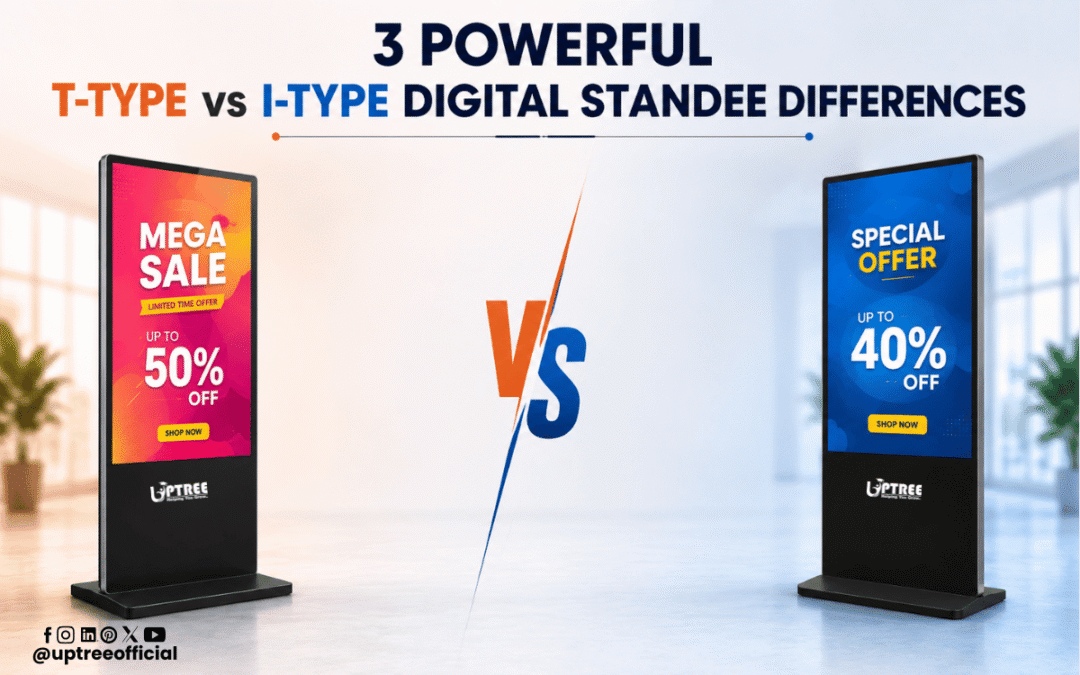
3 Powerful T-Type vs I-Type Digital Standee Differences
3 Powerful T-Type vs I-Type Digital Standee Differences is an important comparison for businesses, schools, retail stores, shopping malls, hotels, hospitals, exhibitions, and other organizations looking for an effective digital advertising solution. Digital standees have become a popular way to display advertisements, announcements, promotional videos, offers, product information, and other visual content. Among the different digital standee designs available today, T-Type and I-Type models are two commonly considered options. Although both are designed to attract attention and display digital content, they have noticeable differences in construction, pricing, and overall design. Understanding these differences can help businesses choose the right digital standee according to their requirements, budget, and installation environment.
When selecting a digital signage solution, simply looking at the screen size or display quality is not always enough. The physical construction, protection of the display, overall thickness, and cost can make a significant difference in practical usage. This is why understanding the 3 Powerful T-Type vs I-Type Digital Standee Differences can make the buying decision easier.
What Is a T-Type Digital Standee?
A T-Type digital standee is a vertical digital display designed with a T-shaped structure. It generally has a strong and stable body with a display mounted vertically in the center. One of the major characteristics of the T-Type digital standee is that the display comes with toughened glass protection.
The toughened glass provides an additional protective layer over the display. This can be especially useful in locations where people frequently interact with or move around the standee. Shopping malls, retail stores, educational institutions, reception areas, exhibitions, and public spaces can benefit from additional protection.
The T-Type design also provides a solid and professional appearance. Its structure can make the display look more substantial, which can be useful for businesses that want their advertising equipment to have a premium physical presence.
When discussing the 3 Powerful T-Type vs I-Type Digital Standee Differences, the toughened glass protection is one of the most important factors to consider. It directly affects the protection and construction of the display.
What Is an I-Type Digital Standee?
An I-Type digital standee is another type of vertical digital display designed for advertising, information sharing, promotions, and digital signage applications. Its structure is generally slimmer and more streamlined than a T-Type digital standee.
One of the main differences is that the I-Type digital standee does not come with toughened glass over the display. Instead, the screen is a direct display without an additional toughened glass layer.
This construction helps reduce the overall thickness of the standee. As a result, I-Type digital standees can be a suitable option for businesses looking for a slim and space-efficient digital signage solution.
The I-Type design can work well in retail environments, offices, reception areas, stores, showrooms, and other locations where available space is limited. Its slim appearance can also give the environment a clean and modern look.
Therefore, the 3 Powerful T-Type vs I-Type Digital Standee Differences are not simply about appearance. They also involve protection, price, and physical thickness.
3 Powerful T-Type vs I-Type Digital Standee Differences
Now, let’s explore the three major differences that businesses should understand before selecting between these two digital standee designs.
1. T-Type Comes With Toughened Glass, While I-Type Has Direct Display
The first and one of the most important points in the 3 Powerful T-Type vs I-Type Digital Standee Differences is the difference in display protection.
A T-Type digital standee comes with toughened glass in front of the display. This glass acts as an additional protective layer. It can provide greater protection against everyday contact and minor external impacts compared with a display that does not have an additional glass layer.
This feature can be valuable in high-traffic locations. For example, imagine a digital standee placed at the entrance of a shopping mall. Hundreds or thousands of people may walk past it every day. Similarly, digital standees installed in schools, exhibitions, retail stores, airports, hotels, and public areas may be exposed to frequent movement and accidental contact.
The toughened glass on a T-Type standee gives businesses an additional layer of protection for such environments.
In contrast, an I-Type digital standee has a direct display without toughened glass. This makes the screen structure more straightforward and helps keep the overall product slimmer.
The absence of toughened glass does not mean that an I-Type digital standee cannot be used for advertising. It can still deliver digital advertisements, promotional content, videos, images, announcements, and other visual information effectively. However, buyers should consider the environment in which the standee will be installed.
If protection is a priority, the T-Type can be a better choice. If a slim structure and lower cost are more important, the I-Type may be more suitable.
This makes the first point in the 3 Powerful T-Type vs I-Type Digital Standee Differences particularly important for businesses that expect their display to be used in busy environments.
Why Toughened Glass Matters
Toughened glass is designed to provide additional strength compared with ordinary glass. In a digital standee, it can also create a protective barrier between the screen and the external environment.
For businesses, this can mean greater peace of mind when the display is installed in a location where accidental contact is possible.
For example:
- Shopping malls can use T-Type standees for promotional campaigns.
- Retail stores can display offers and new product announcements.
- Schools can use them for notices and event information.
- Hotels can use them for reception and promotional communication.
- Exhibitions can use them for product presentations.
- Corporate offices can use them for visitor information and announcements.
This is why the protection factor should be considered carefully when evaluating the 3 Powerful T-Type vs I-Type Digital Standee Differences.
2. T-Type Digital Standee Is Costlier Than I-Type
The second major difference in the 3 Powerful T-Type vs I-Type Digital Standee Differences is the price.
Generally, a T-Type digital standee is costlier than an I-Type digital standee. One of the reasons for this difference is the additional construction and toughened glass protection used in the T-Type model.
When purchasing digital signage equipment, businesses often have to balance features and budget. A higher price does not automatically mean that one product is better for every application. Instead, the right product depends on what the business actually needs.
A T-Type standee can be a worthwhile investment for organizations that value additional screen protection and a stronger physical design. Businesses installing displays in busy public locations may consider the additional investment useful.
On the other hand, an I-Type standee can be attractive for organizations that want an effective digital advertising display at a comparatively lower cost. Its simpler construction and direct display design contribute to its slim structure and lower price.
For startups, small businesses, retail outlets, promotional campaigns, and organizations working with a limited budget, the I-Type can provide a practical digital signage option.
This pricing difference is one of the most useful aspects of the 3 Powerful T-Type vs I-Type Digital Standee Differences because it helps businesses match the product with their available budget.
Choosing According to Budget
Before purchasing a digital standee, businesses should identify their primary objective.
If the priority is:
- Additional display protection
- Stronger physical construction
- A more substantial standee appearance
- Installation in busy environments
Then a T-Type digital standee can be considered.
If the priority is:
- Lower investment
- Slim design
- Space efficiency
- Simple digital advertising
- Budget-friendly signage
Then an I-Type digital standee can be considered.
Understanding the 3 Powerful T-Type vs I-Type Digital Standee Differences allows buyers to avoid spending more than necessary or choosing a product that does not meet their operational requirements.
3. I-Type Digital Standee Is Slimmer Than T-Type
The third major point in the 3 Powerful T-Type vs I-Type Digital Standee Differences is thickness.
An I-Type digital standee is slimmer than a T-Type digital standee. This is mainly associated with its direct display design and the absence of an additional toughened glass layer.
The slimmer construction can be particularly useful in locations where space is limited. Retail shops, reception desks, corridors, offices, showrooms, and compact promotional areas may benefit from a more streamlined digital signage solution.
A slim standee can also provide a modern and minimal appearance. Businesses that prefer a clean interior design may find the I-Type attractive because it does not have the additional bulk associated with a protected T-Type structure.
The T-Type, in comparison, has a more substantial structure because it incorporates toughened glass protection. While this makes it thicker, it also provides the benefit of an additional protective layer.
Therefore, there is a practical trade-off between protection and slimness.
This is an important consideration when analyzing the 3 Powerful T-Type vs I-Type Digital Standee Differences.
Why Slim Design Can Be Important
The physical size of a digital standee can influence where it can be installed. A slimmer product can be easier to accommodate in areas with restricted space.
For example, an I-Type standee may be useful near:
- Retail counters
- Store entrances
- Office reception areas
- Narrow corridors
- Showrooms
- Exhibition spaces
- Hotel reception areas
- Promotional zones
A T-Type standee can be more appropriate where physical protection and a stronger structure are more important than minimum thickness.
Thus, the third point in the 3 Powerful T-Type vs I-Type Digital Standee Differences should be considered along with the available installation space.
T-Type vs I-Type Digital Standee: Which One Should You Choose?
After understanding the 3 Powerful T-Type vs I-Type Digital Standee Differences, the next question is which model is right for your business.
There is no universal answer because every business has different requirements.
A T-Type digital standee can be a good choice when protection is a major concern. The toughened glass gives the display an additional protective layer, while its stronger construction provides a premium and substantial appearance.
An I-Type digital standee can be a better choice when the business wants a slimmer and more budget-friendly display. Its direct display design helps reduce thickness and cost.
The decision should therefore be based on three main factors:
Protection: If additional screen protection is important, consider T-Type.
Budget: If keeping the initial investment lower is important, consider I-Type.
Space: If a slimmer display is preferred, consider I-Type.
These three factors summarize the 3 Powerful T-Type vs I-Type Digital Standee Differences and can make the selection process much easier.
Applications of T-Type and I-Type Digital Standees
Both types of digital standees can be used across a wide range of industries. Their main purpose is to communicate information digitally in an attractive and engaging format.
Retail Stores
Retail businesses can use digital standees to promote discounts, seasonal offers, new arrivals, product information, and promotional campaigns.
Shopping Malls
Shopping malls can use digital displays to promote stores, products, events, offers, and important visitor information.
Educational Institutions
Schools, colleges, coaching institutes, and universities can use digital standees for announcements, admission campaigns, event information, and educational communication.
Hotels
Hotels can use digital standees in reception and lobby areas to display welcome messages, events, facilities, restaurant promotions, and other information.
Corporate Offices
Businesses can use digital signage for visitor communication, employee announcements, corporate branding, event information, and internal communication.
Exhibitions and Events
Digital standees are particularly useful at exhibitions because they can display videos and promotional content without requiring traditional printed advertising materials.
The best choice between the two should still be made by considering the 3 Powerful T-Type vs I-Type Digital Standee Differences and the specific requirements of the installation environment.
Why Businesses Are Choosing Digital Standees
Traditional posters and printed advertisements have limitations. Once a poster is printed, changing its content usually requires creating and installing a new poster.
Digital standees offer more flexibility. Businesses can display images, videos, promotional messages, announcements, and other digital content on the same display.
This makes them useful for dynamic advertising campaigns.
A business can change its promotional content according to different campaigns, seasons, products, events, or offers. This flexibility can help businesses create a more engaging communication experience.
However, selecting the right physical design remains important. The 3 Powerful T-Type vs I-Type Digital Standee Differences help businesses understand the practical differences between the two options.
T-Type vs I-Type: Quick Comparison
| Feature | T-Type Digital Standee | I-Type Digital Standee |
|---|---|---|
| Display Protection | Toughened glass | Direct display |
| Price | Comparatively higher | Comparatively lower |
| Thickness | Thicker | Slimmer |
| Design | Stronger, substantial structure | Slim and streamlined |
| Ideal For | Locations where added protection is preferred | Locations where slimness and budget are priorities |
This comparison provides a quick overview of the 3 Powerful T-Type vs I-Type Digital Standee Differences.
Final Thoughts
The 3 Powerful T-Type vs I-Type Digital Standee Differences can help businesses make a more informed decision when selecting digital signage. Although both standees can be used for advertising and information display, their construction, cost, and thickness make them suitable for different requirements.
The first major difference is protection. T-Type digital standees come with toughened glass, while I-Type digital standees have a direct display without toughened glass.
The second difference is price. T-Type digital standees are generally costlier than I-Type digital standees because of their construction and additional protection.
The third difference is thickness. I-Type digital standees are slimmer than T-Type models, making them a practical option for businesses looking for a sleek and space-efficient display.
Ultimately, the best option depends on your business requirements. If additional protection is a priority, T-Type may be the right choice. If affordability and a slimmer design are more important, I-Type can be a practical alternative.
At Uptree, we understand that every business has different digital signage requirements. Our goal is to help businesses choose suitable digital display solutions based on their application, space, budget, and communication needs.
Before making a purchase, carefully consider the 3 Powerful T-Type vs I-Type Digital Standee Differences and evaluate which features are most important for your location. The right digital standee can become an effective communication tool that helps businesses present advertisements, offers, information, and branding content in a modern and engaging way.
Whether you choose a T-Type or I-Type digital standee, understanding these differences will help you make a more confident purchasing decision. The 3 Powerful T-Type vs I-Type Digital Standee Differences provide a simple starting point for comparing protection, price, and slimness and selecting the digital signage solution that best matches your requirements.
To learn more about the Uptree Digital Standee, explore our related blogs:
-
Top 10 High-Quality Digital Standee Features: Read More
-
Difference Between a Wall Mount Standee and a Smart TV: Read More
-
Turn Diners into Engaged Customers with Digital Standee: Read More