
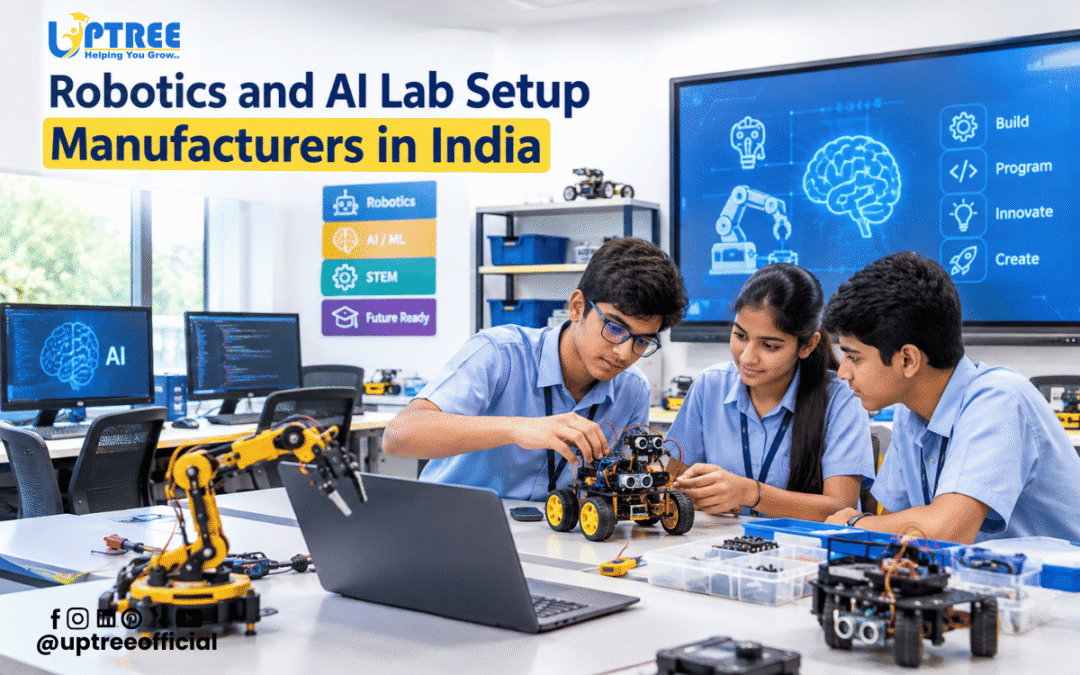
Robotics and AI Lab Setup in India
Robotics and AI Lab Setup in India is helping educational institutions introduce modern technology, practical learning, and innovation into classrooms. As schools, colleges, universities, and training institutes adopt technology-driven education, the demand for well-equipped robotics and artificial intelligence laboratories continues to grow. Uptree Consultancy Services Private Limited supports educational institutions with advanced technology solutions, customized lab infrastructure, and smart learning environments designed to prepare students for the future.
Introduction to Robotics and AI Lab Setup
Education is evolving beyond textbooks and traditional teaching methods. Students need opportunities to explore technology, experiment with ideas, solve problems, and develop practical skills. Robotics and artificial intelligence laboratories provide the right environment for this type of learning.
When institutions collaborate with Robotics and AI Lab Setup in India, they can develop learning spaces equipped with robotics kits, AI learning tools, programming systems, electronic components, sensors, and other educational technologies.
A well-designed robotics and AI lab encourages students to understand how technology works in real-world applications. From building simple robotic models to learning machine learning concepts, students can develop technical knowledge through hands-on activities.
Uptree aims to support institutions in establishing technology-enabled educational environments that promote creativity, computational thinking, and practical learning.
What Is a Robotics and AI Lab?
A robotics and AI lab is a specialized learning space where students explore robotics, automation, programming, electronics, artificial intelligence, and related technologies.
These laboratories combine hardware and software to help students understand how machines interact with their surroundings, process information, and perform specific tasks.
Depending on the educational level and institution’s requirements, a robotics and AI lab may include:
- Educational robotics kits
- Artificial intelligence learning tools
- Machine learning demonstration systems
- Microcontrollers and development boards
- Sensors and electronic components
- Coding and programming platforms
- Robotic arms and automation models
- STEM learning equipment
- Internet of Things (IoT) development kits
- Computers and software for programming
- Project-based learning resources
Professional Robotics and AI Lab Setup in India helps institutions identify suitable equipment and organize these resources according to available space, curriculum, student age groups, and learning objectives.
Why Robotics and AI Labs Are Important in Modern Education
Technology is influencing almost every industry, including healthcare, manufacturing, agriculture, transportation, education, and business. Introducing robotics and AI concepts at an early stage can help students understand these changes and develop relevant skills.
1. Encourages Practical Learning
Practical learning allows students to apply theoretical knowledge through experiments and projects. Instead of only reading about sensors, motors, or algorithms, students can build models and observe how different components work together.
A robotics lab provides opportunities to assemble robots, write programs, test movements, and improve designs. These activities make technical concepts easier to understand.
2. Develops Problem-Solving Skills
Robotics projects frequently involve challenges such as programming errors, sensor limitations, and mechanical issues. Students learn to identify problems, test possible solutions, and improve their designs.
This process develops logical thinking, patience, creativity, and analytical skills.
3. Introduces Artificial Intelligence Concepts
Artificial intelligence is increasingly used in intelligent applications, image recognition, speech processing, data analysis, and automation.
An AI lab introduces students to foundational concepts through age-appropriate demonstrations, coding exercises, and guided projects. Advanced learners can explore datasets, machine learning models, computer vision, and intelligent automation.
4. Supports STEM Education
STEM stands for Science, Technology, Engineering, and Mathematics. Robotics and AI laboratories bring these subjects together through practical projects.
Students may apply mathematical calculations, scientific principles, engineering concepts, and programming techniques to create working models.
5. Promotes Innovation and Creativity
Students can use laboratory equipment to develop their own ideas, build prototypes, and participate in innovation competitions. These experiences encourage independent thinking and collaborative learning.
By working with experienced Robotics and AI Lab Setup in India, institutions can create environments that support experimentation and innovation.
Why Choose Uptree for Robotics and AI Lab Setup?
Uptree Consultancy Services Private Limited provides educational technology and business solutions designed to support institutions in adopting modern learning infrastructure.
For schools, colleges, universities, and training centres planning to introduce robotics and AI education, Uptree can help identify suitable technology solutions based on institutional requirements.
Customized Laboratory Solutions
Every institution has different requirements. A primary school may need beginner-friendly robotics kits, while an engineering college may require advanced programming equipment and automation systems.
Uptree can help plan laboratory solutions according to the institution’s objectives, student capacity, available space, and budget.
Solutions for Different Educational Levels
Robotics and AI learning should match students’ existing knowledge and technical abilities.
Laboratory requirements can be planned for:
- Primary and secondary schools
- CBSE and state-board institutions
- Higher secondary schools
- Colleges and universities
- Engineering institutions
- Vocational training centres
- Skill development institutes
- Educational innovation centres
Technology Integration
A productive laboratory requires more than individual robotics kits. It may also need computers, displays, software, connectivity, and suitable classroom infrastructure.
Uptree’s broader educational technology offerings, including interactive flat panels and computer solutions, can complement laboratory environments where these technologies are required.
End-to-End Planning Support
Institutions benefit from a structured approach that considers equipment selection, space planning, installation requirements, demonstrations, and user training.
When evaluating Robotics and AI Lab Setup in India, institutions should look for providers who understand both educational objectives and technical requirements.
Essential Components of a Robotics and AI Lab
The right equipment depends on the age group, syllabus, available budget, and expected learning outcomes. The following components are commonly considered during laboratory planning.
1. Robotics Kits
Robotics kits are among the primary resources used in practical robotics education. They may contain structural components, motors, wheels, sensors, controllers, and programmable modules.
Students can use these kits to build line-following robots, obstacle-avoiding robots, automated vehicles, and other educational models.
Beginner kits should be easy to assemble, while advanced kits may support complex mechanisms and programmable automation.
2. Artificial Intelligence Learning Tools
AI learning tools help students understand how computers can identify patterns, interpret information, and generate predictions.
Depending on the learning level, these tools may include visual AI platforms, supervised machine learning exercises, image recognition demonstrations, and computer vision projects.
Institutions should select age-appropriate tools that explain AI concepts clearly and encourage responsible technology use.
3. Computers and Programming Systems
Computers are essential for writing code, developing projects, running simulations, and connecting with programmable devices.
A lab may require desktop computers, all-in-one PCs, or other compatible systems depending on the software and hardware being used.
The configuration should be selected according to the intended applications, software requirements, memory needs, and number of students.
4. Sensors and Electronic Components
Sensors help robots collect information from their surroundings. Common educational components include ultrasonic sensors, infrared sensors, light sensors, temperature sensors, and motion-related modules.
Students can connect these components to controllers and develop projects that respond to environmental changes.
Electronic components such as LEDs, switches, resistors, wires, and breadboards help students understand basic circuit design and electronics.
5. Microcontrollers and Development Boards
Microcontrollers and development boards allow students to control motors, read sensor data, and develop automated systems.
These components are widely used in beginner and intermediate robotics projects. More advanced learners may explore embedded programming and IoT applications.
6. Robotic Arms and Automation Models
Robotic arms demonstrate movement, positioning, gripping, and basic industrial automation concepts.
Students can study how programmed instructions control movement and how sensors improve automation.
These models can help connect classroom learning with applications in manufacturing, packaging, logistics, and other industrial environments.
7. Interactive Displays and Teaching Infrastructure
An interactive flat panel can help teachers explain programming logic, demonstrate simulations, display project instructions, and collaborate with students.
When combined with computers and practical equipment, an interactive display supports both theoretical explanations and hands-on demonstrations.
Educational institutions can consider integrating such solutions into their laboratory design where appropriate.
Types of Robotics and AI Labs for Educational Institutions
Different institutions require different laboratory configurations. Leading Robotics and AI Lab Setup in India should be able to recommend equipment based on the institution’s teaching goals.
School Robotics Lab
A school robotics lab introduces students to fundamental concepts through simple construction activities, visual programming, sensors, and basic automation.
Suitable projects may include obstacle-avoiding robots, smart traffic lights, automated plant-watering models, and basic environmental monitoring systems.
The focus should be on exploration, teamwork, creativity, and understanding basic engineering principles.
AI and Machine Learning Lab
An AI and machine learning lab introduces students to data, algorithms, pattern recognition, and intelligent applications.
Depending on the curriculum, students may work with image classification, speech-related applications, simple prediction models, and introductory computer vision projects.
Advanced institutions may require more capable computers and specialized software.
STEM Innovation Lab
A STEM lab combines science, technology, engineering, and mathematics through interdisciplinary activities.
Students can design prototypes, conduct experiments, build electronic models, and test solutions to real-world problems.
Such laboratories encourage curiosity and provide a foundation for further studies in technology and engineering.
Advanced Robotics and Automation Lab
Advanced laboratories may include programmable robotic arms, automation models, embedded systems, industrial sensors, and specialized programming environments.
These setups are suitable for technical institutions and skill development centres that want to provide more advanced practical training.
IoT and Smart Technology Lab
An IoT lab helps students explore connected devices, sensor networks, data collection, and remote monitoring.
Projects may include smart lighting, environmental monitoring, energy management demonstrations, and connected irrigation systems.
Combining IoT with robotics and AI can help students understand how intelligent systems interact with real-world environments.
How to Select the Right Robotics and AI Lab Setup in India
Choosing a suitable provider is an important step in establishing a successful laboratory. Institutions should consider more than the number of products included in a quotation.
1. Understand Your Educational Objectives
Start by identifying what students should learn from the laboratory. Determine whether the focus is on introductory robotics, AI fundamentals, coding, electronics, IoT, or advanced automation.
Clear learning objectives help determine the equipment and software required.
2. Evaluate Product Quality and Compatibility
Check the quality, durability, and compatibility of the proposed components. Robotics kits, sensors, controllers, computers, and software should work together as intended.
Ask for demonstrations or technical documentation before finalizing the equipment.
3. Consider Curriculum Alignment
Laboratory activities should complement the institution’s educational programme. Review whether the proposed resources support the intended syllabus, student age group, and learning outcomes.
A suitable setup should allow students to progress from foundational exercises to more complex projects.
4. Check Installation and Training Support
Proper installation and guidance can help teachers use the laboratory effectively.
Ask the provider about setup support, teacher orientation, operating instructions, troubleshooting assistance, and maintenance arrangements.
5. Compare the Total Cost
The total laboratory investment may include hardware, computers, software, furniture, installation, training, consumables, and maintenance.
Institutions should compare quotations based on the complete scope of supply rather than the initial equipment price alone.
6. Review After-Sales Service
Technical assistance is important when equipment requires troubleshooting, replacement, or updates.
Before selecting a provider, clarify warranty terms, support availability, replacement policies, and service coverage.
These considerations can help institutions evaluate Robotics and AI Lab Setup in India and select a solution that offers long-term educational value.
Steps Involved in Setting Up a Robotics and AI Lab
A systematic implementation process makes laboratory planning easier and reduces the risk of purchasing unsuitable equipment.
Step 1: Requirement Analysis
Identify the student age groups, number of learners, subjects, project objectives, and available budget.
Step 2: Space Assessment
Evaluate the available room, workstations, electrical points, ventilation, storage, network connectivity, and safety requirements.
Step 3: Equipment Selection
Choose suitable robotics kits, computers, controllers, sensors, software, and supporting teaching technologies.
Step 4: Laboratory Layout Planning
Arrange workstations to provide sufficient working space, safe movement, easy access to equipment, and collaborative learning opportunities.
Step 5: Installation and Configuration
Set up the equipment, configure compatible software, test connections, and verify that the proposed activities can be performed.
Step 6: Teacher Training and Demonstration
Provide teachers with appropriate guidance on equipment operation, classroom activities, basic troubleshooting, and project implementation.
Step 7: Ongoing Maintenance
Establish procedures for equipment storage, inventory management, software updates, repairs, and regular performance checks.
Experienced Robotics and AI Lab Setup in India can help institutions organize these stages according to their project scope.
Benefits of Investing in a Robotics and AI Lab
A properly planned laboratory can offer several educational benefits.
Practical technical skills: Students gain experience with programming, electronics, robotics, and automation.
Logical thinking: Projects encourage students to break complex problems into smaller, manageable steps.
Collaboration: Group activities teach learners how to communicate, share responsibilities, and develop solutions together.
Career awareness: Students become familiar with technology fields such as robotics engineering, artificial intelligence, embedded systems, and automation.
Innovation opportunities: Practical work allows students to create prototypes and explore ideas beyond conventional classroom exercises.
Technology readiness: Early exposure to emerging technologies can help students make informed decisions about further education and career interests.
The educational impact depends on the quality of instruction, regular laboratory use, appropriate equipment, and opportunities for students to apply what they learn.
Robotics and AI Lab Setup Cost in India
The cost of a robotics and AI laboratory varies according to its size, complexity, equipment selection, and intended educational level.
A basic school laboratory may focus on entry-level robotics kits, simple sensors, controllers, and existing computers. A more advanced setup may include dedicated computer systems, robotic arms, AI development tools, IoT equipment, and specialized software.
Factors affecting the overall cost include:
- Number of student workstations
- Quantity and type of robotics kits
- Computer specifications
- AI and programming software
- Sensors and electronic components
- Robotic arms and automation equipment
- Furniture and electrical infrastructure
- Installation and teacher training
- Warranty and maintenance requirements
Institutions should request a customized quotation based on their actual needs. Robotics and AI Lab Setup in India may offer different equipment combinations, so comparing the specifications, inclusions, and service terms is essential.
Uptree can help institutions explore educational technology requirements and identify suitable solutions based on their project objectives and budget.
Future Scope of Robotics and Artificial Intelligence Education
Robotics and AI are becoming increasingly important in technology development and industrial innovation. Automated production systems, intelligent software, connected devices, and data-driven applications are influencing how organizations operate.
Introducing these subjects in educational institutions helps students develop foundational knowledge of emerging technologies.
In the future, educational laboratories may increasingly combine robotics, AI, IoT, computer vision, simulation, and project-based learning. Students may also use these resources to explore sustainability, agriculture, healthcare, environmental monitoring, and smart-city applications.
However, effective technology education requires more than equipment. Teachers need appropriate training, students need regular practice, and institutions should provide structured learning activities that encourage responsible experimentation.
By investing in well-planned laboratories, schools and colleges can create opportunities for students to understand technology through practical experience.
Why Uptree Is a Suitable Technology Partner for Educational Institutions
Uptree Consultancy Services Private Limited works in educational technology and business solutions, helping institutions explore technology infrastructure for modern learning environments.
When planning a robotics and AI lab, institutions should look for solutions that match their curriculum, available resources, and long-term objectives.
Uptree can support the broader technology requirements of educational spaces through solutions such as interactive flat panels, computer systems, digital classroom technologies, and related infrastructure. These technologies can complement robotics and AI activities by supporting demonstrations, collaborative learning, and programming work.
Institutions planning a new laboratory should discuss their specific requirements, including student capacity, preferred activities, available space, equipment needs, and budget.
Selecting suitable Robotics and AI Lab Setup Manufacturers in India requires careful evaluation of equipment, implementation support, compatibility, and service commitments.
Uptree aims to help educational institutions make informed technology decisions and develop learning environments that support practical education.
Frequently Asked Questions (FAQs)
1. What is a robotics and AI lab?
A robotics and AI lab is an educational facility where students learn robotics, programming, electronics, artificial intelligence, and automation through practical activities and projects.
2. Who needs a robotics and AI lab?
Schools, colleges, universities, engineering institutions, vocational training centres, and skill development institutes can benefit from robotics and AI laboratories.
3. What equipment is required for a robotics and AI lab?
Common equipment includes robotics kits, sensors, microcontrollers, computers, programming software, electronic components, AI learning tools, and project materials. Advanced labs may also include robotic arms and IoT development kits.
4. How much does a robotics and AI lab cost in India?
The cost depends on the number of students, equipment specifications, software requirements, infrastructure, and installation needs. Institutions should request a customized quotation based on their objectives.
5. Can a robotics and AI lab be customized for schools?
Yes. Equipment and activities can be selected according to student age groups, curriculum requirements, available space, and budget.
6. Why should institutions compare robotics and AI lab providers?
Comparing providers helps institutions evaluate product quality, compatibility, installation, teacher training, warranty, maintenance, and overall project cost.
7. Does a robotics and AI lab require computers?
Computers are commonly required for programming, simulation, software applications, and AI activities. The exact specifications depend on the selected equipment and curriculum.
8. How can Uptree help educational institutions?
Uptree offers educational technology and business solutions, including interactive flat panels, computer systems, and digital classroom technologies that can complement modern laboratory environments.
Conclusion
Robotics and AI Lab Setup in India plays an important role in helping educational institutions introduce practical technology education. A well-designed laboratory can encourage creativity, improve problem-solving skills, and introduce students to robotics, artificial intelligence, programming, and automation.
From school-level robotics kits to advanced AI and engineering resources, the right laboratory setup depends on educational objectives, equipment compatibility, teacher training, and long-term support.
Uptree Consultancy Services Private Limited aims to support modern educational environments through technology solutions tailored to institutional requirements. Schools, colleges, universities, and training centres can explore suitable infrastructure options to create engaging, technology-enabled learning spaces.
If your institution is planning a robotics and AI lab, connect with Uptree to discuss your requirements and explore suitable educational technology solutions.
To learn more about Uptree Products & Services, explore our related blogs:
-
Best Interactive Flat Panel Manufacturer in Ahmedabad: Read More
-
Top 10 High-Quality Digital Standee Features: Read More
-
PTZ Camera for Professional Online Studio Setup: Read More
-
Why Choose an All-In-One PC for Modern Office Setup?: Read More
- Best Robotics & AI Lab Setup Provider in Ahmedabad: Read More